

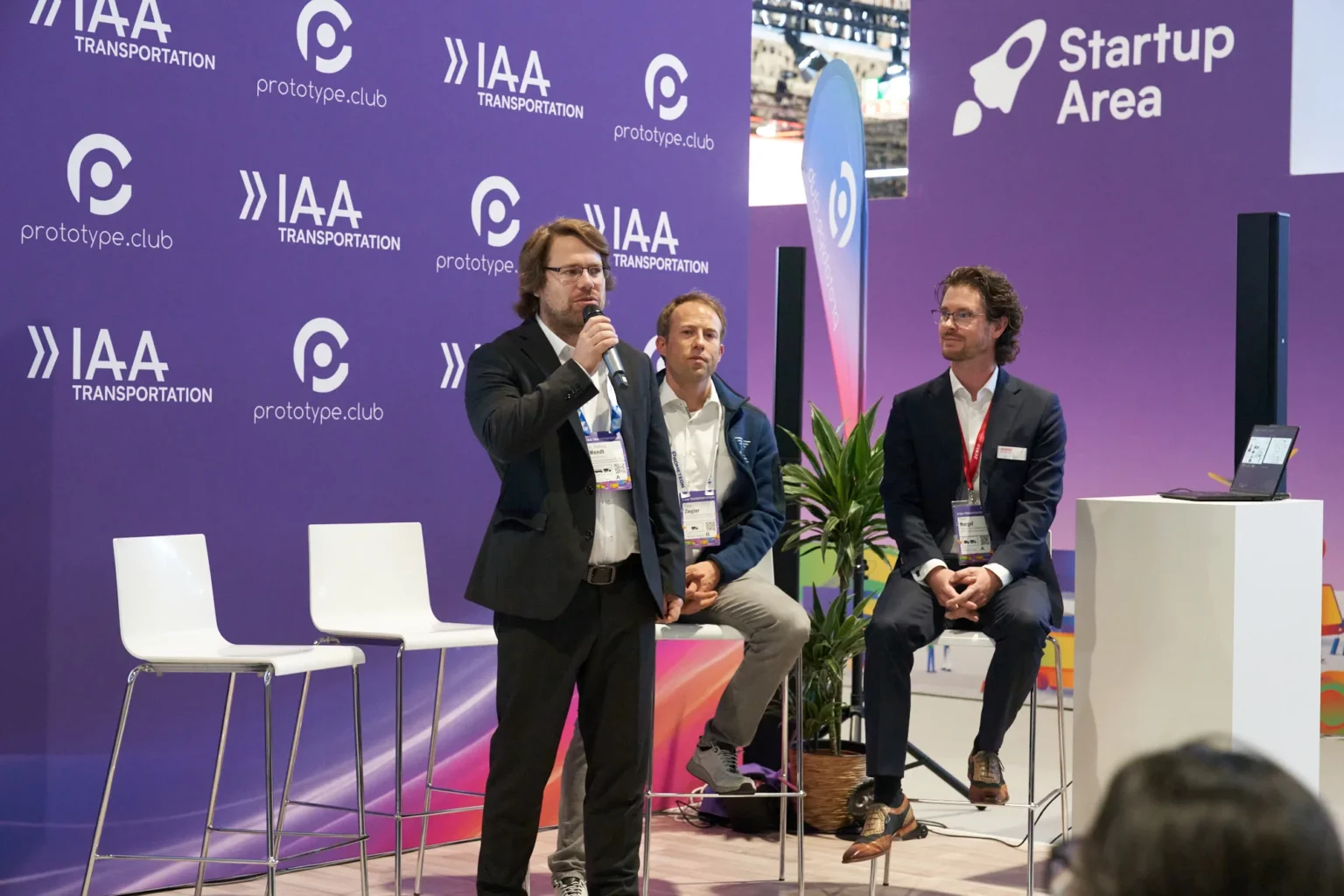
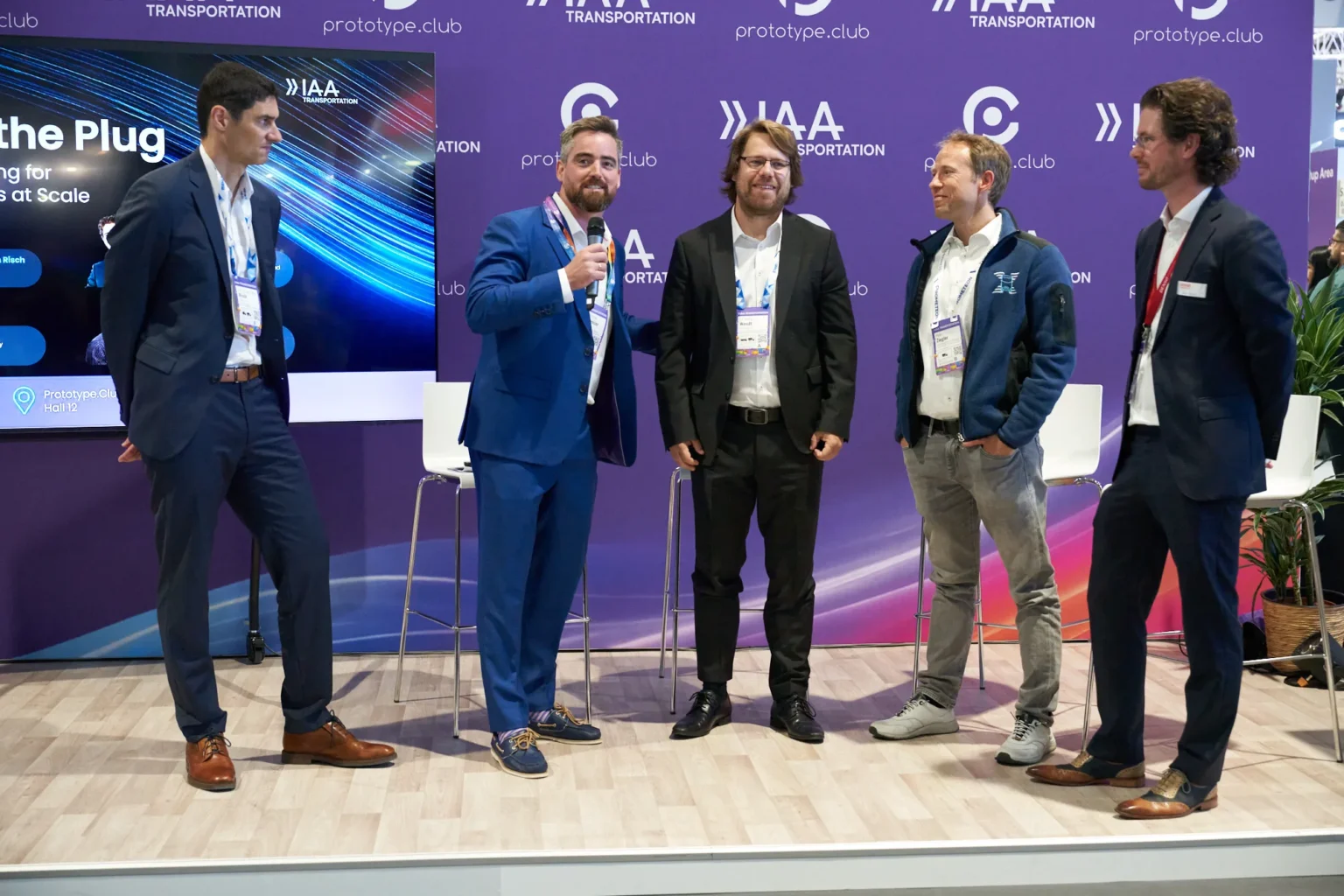
Electrifying five vehicles is one thing. Electrifying a fleet of hundreds becomes an infrastructure project. At IAA TRANSPORTATION 2026, Daimler Truck, DENSO, Electreon and FAU Erlangen-Nürnberg joined us on the IAA.prototype.club Stage to discuss how wireless charging is helping commercial fleets move from successful pilots to real-world scale.
Electric commercial vehicles have arrived. But as fleets grow, the challenge changes.
During the panel “Beyond the Plug: Rethinking Charging for Commercial Fleets at Scale,” Andreas Wendt from Electreon described a pattern the company repeatedly encounters in conversations with fleet operators: Companies start with five, ten or twenty electric vehicles. A few chargers are installed, operations adapt, and the vehicles get the energy they need. But what happens when 20 vehicles become several hundred?
“When you move to a handful of electric vehicles, this is procurement. But when you move to an electric fleet, like a few hundred vehicles, this is an infrastructure project.”
When charging becomes an infrastructure problem
Scaling an electric fleet means more than simply installing additional chargers. The right vehicles need to charge at the right time, charging has to fit into existing operations, and space at depots is limited. Even if enough charging points can physically be installed, the available grid connection may not allow every vehicle to charge at full power simultaneously.
This is where wireless charging becomes particularly interesting: Instead of treating charging as a separate process, energy can be transferred during periods when the vehicle is already stationary – and, if needed, even while it is moving.

Charge where the vehicle already stops
One particularly relevant use case is logistics. Commercial vehicles regularly spend thirty minutes or an hour at loading docks while goods are loaded or unloaded. At the same time, many logistics sites simply do not have enough space between docks for additional charging posts.
Wireless charging changes that equation: Charging infrastructure can be integrated into the space beneath the vehicle, allowing it to receive energy while normal operations continue. Electreon has developed retrofit solutions to bring this capability to existing fleets. According to Dr. Wendt, the architecture can in principle be adapted to almost any van and truck topology.
Wireless charging for commercial fleets
A working truck prototype in three weeks
One of the most tangible examples from the panel came from Daimler Truck. Peter Ziegler described how Electreon approached Daimler Truck with a wireless charging system to be integrated into a truck.
Instead of requiring a fundamentally new charging architecture in the vehicle, the teams found another approach: Electreon’s system could emulate conductive charging towards the truck. The result was a working proof of concept – according to Ziegler, Electreon implemented it within three weeks.
It demonstrates that stationary wireless charging does not necessarily have to begin with an entirely new vehicle platform, but can potentially be combined with existing vehicles and charging architectures.
From 11 kW to 300 kW – stationary and in motion
Electreon’s approach is not limited to a single charging scenario. At IAA TRANSPORTATION, the company presented solutions ranging from 11 kW to 300 kW, covering both stationary wireless charging and energy transfer while vehicles are in motion. Electreon is already involved in commercial projects in Europe, Japan and the United States.
The near-term application is straightforward: charge vehicles wirelessly where they already stop during normal operations. The longer-term vision goes further. Dynamic wireless charging – often referred to as an Electric Road System (ERS) – could supply vehicles with energy while driving, meaning that part of the required energy could come directly from the infrastructure.
Could better charging enable smaller batteries?
Battery size is one of the central economic and technical questions for electric commercial vehicles. Large batteries provide range, but they also increase cost, weight and resource demand.
Electreon argued on stage that more frequent access to energy could change this trade-off. A distribution vehicle that can recharge several times throughout its working day may not require the same battery capacity as a vehicle that has to carry all the energy it needs when leaving the depot.
The question then changes from “How large does the battery need to be?” to “How much energy does a vehicle actually need to carry if charging becomes part of the infrastructure around it?”
From proof of concept to proof of business
Technical feasibility alone will not determine whether wireless charging scales. Vehicle manufacturers, suppliers, charging providers, fleet operators, infrastructure operators, energy companies, regulators and researchers all need to work together. Standards and interfaces need to become interoperable, while vehicle integration needs to be industrialized.
The maturity of the technology already differs significantly between applications. Stationary wireless charging has moved beyond the proof-of-concept stage, with solutions already integrated into more than 200 EV models across Europe and the US and commercially operational projects in the market. Dynamic wireless charging and Electric Road Systems (ERS), however, are still largely at the pilot and proof-of-concept stage.
For these dynamic applications in particular, fleet operators now need evidence that the technology delivers measurable operational and economic benefits. As DENSO’s Kevin Norgel put it during the panel, the next logical step is not simply another proof of concept, but a “proof of business”: real fleets and real-world data need to demonstrate the impact dynamic wireless charging can have on vehicle uptime, range, infrastructure utilization and total cost of ownership.
“The next logical step is to make a proof of business.”
Finding the pioneers
For Electreon, this transition is already becoming concrete. Commercial projects are operating internationally and existing vehicles can be retrofitted. What is needed now are fleet operators and partners willing to deploy the technology under real operating conditions.
Andreas Wendt summarized it on stage:
“We need pioneers to move forward.”
That may be the central message from the discussion on the IAA.prototype.club Stage. Once a handful of electric vehicles becomes a fleet of hundreds or thousands, charging becomes part of a much larger system.
The plug will remain part of that system. Wireless charging, however, adds another possibility: making energy available where vehicles already stop – and one day, wherever they drive.
“Beyond the Plug” means giving electric fleets more freedom — combining wired and wireless charging to charge where, when, and how operations need it.
Watch the full panel

You might also be interested in

This was AGRITECHNICA ASIA 2026
AGRITECHINCA ASIA 2026 was our first open innovation format held on Thai soil: With German and international partners onboard, the hackathon and matchmaking turned highly impactful.

Siemens Energy and Infinite Foundry
Siemens Energy and Infinite Foundry cooperated successful on the challenging task of remote offline asset localization and tracking for ground robots.

This was Bosch CONNECTED EXPERIENCE 2024
Co-organizing the BCX 24 with Bosch and experience intense hackthons around digital.auto and digital.industry!